Why This Is Worth Your Attention
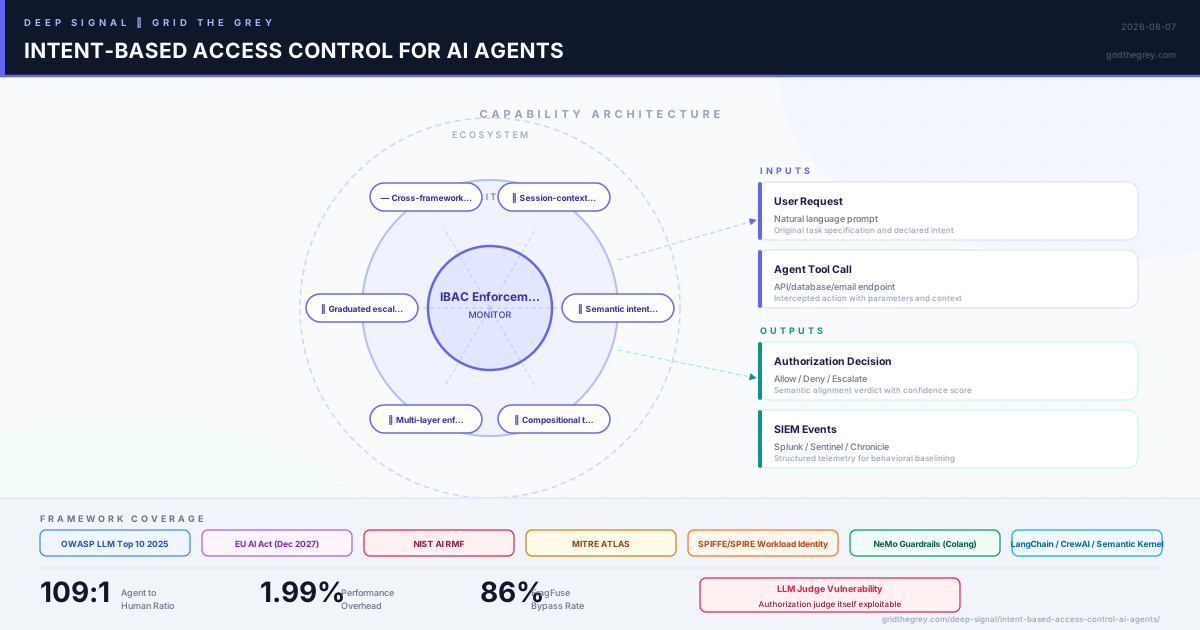
AI agents now outnumber humans in enterprise environments 109 to 1, and every one of those agents carries credentials broader than any single task requires. When an agent authorized for database reads and external email performs both actions in sequence—reading customer PII then sending email to an unknown recipient—traditional access control sees two legitimate operations. What it misses is data exfiltration. This is the compositional threat problem: actions that pass individual permission checks but form harmful sequences when combined. Role-Based Access Control asks “does this agent have the required role?” Attribute-Based Access Control asks “do the attributes satisfy the policy?” Neither can answer “does this action align with what the user actually asked the agent to do?”
Intent-Based Access Control closes this gap by evaluating every agent action against accumulated session context—the user’s original natural-language request, the full action history, data classifications accessed, and tool outputs incorporated. Where RBAC and ABAC evaluate actions in isolation, IBAC treats authorization as a continuous session-level assessment. The EU AI Act’s December 2027 deadline for high-risk autonomous AI systems explicitly mandates risk mitigation and human oversight measures that IBAC operationalizes. OWASP’s LLM Top 10 for 2025 identifies Excessive Agency as a top-tier risk, defining mitigation as granting agents “only the minimum capability needed for the current task”—the operational definition of IBAC.
The technology sits at an inflection point. No vendor ships a product explicitly branded as “Intent-Based Access Control for AI Agents,” but the capability exists across three non-unified layers: identity and credential management, guardrail and intent classification, and action-outcome validation. Security architects must compose solutions today while watching for vendor consolidation. The performance overhead is proven manageable—1.99% in production-grade implementations—and the structural threat is present wherever agents execute write operations, access financial systems, or touch production infrastructure.
What It Actually Is
Intent-Based Access Control is an authorization paradigm that intercepts every tool invocation an AI agent attempts and evaluates whether that action semantically aligns with the user’s stated purpose. Think of it as a security guard with perfect memory who knows not just what you’re allowed to do, but what you said you were going to do. Traditional access control hands you a key and says “you can open this door.” IBAC hands you a key and says “you can open this door if it’s on the way to the conference room you said you were visiting—and if you’ve already checked in at the front desk like you claimed you would.”
The enforcement mechanism maintains a running context record for each agent session: the original user request, every action taken so far, every piece of data touched, and the semantic relationship between the current proposed action and the declared intent. When an agent orchestrated by LangChain or CrewAI calls a tool—whether that’s querying a database, sending an email, or invoking an external API—the IBAC layer intercepts the call before execution. It computes a semantic distance metric between the proposed action and the intent anchor established at session start. If the distance is small and the action history shows no suspicious patterns, execution proceeds. If the distance is large, the action is blocked. If uncertainty is high, the system escalates to a human reviewer.
Consider a customer service agent authorized to “look up order status and send confirmation emails.” A user asks “What’s the status of order 12345?” The agent queries the database—this action sits close to the intent anchor, so it proceeds. The agent then attempts to email the result to [email protected]—still aligned. But if the agent suddenly tries to query all customer records from the past year and email them to a personal Gmail address, IBAC flags the semantic drift. The individual permissions technically allow both actions, but the composite behavior violates the declared intent. IBAC blocks the exfiltration attempt and logs it as a policy violation, even though no static permission boundary was crossed.
Where It Fits in Your Stack
IBAC occupies the enforcement layer between your agent orchestration framework and the resources agents access. It does not replace Identity and Access Management—it extends IAM by adding session-context awareness that static policies cannot provide. Your existing Entra ID, Okta, or IAM roles define what an agent can do in theory; IBAC enforces what the agent should do given its current task. The two systems work in tandem: IAM provides the baseline permission envelope, and IBAC dynamically narrows that envelope to match real-time intent.
Architecturally, IBAC implementations fall into three patterns. The protocol gateway pattern interposes a proxy between agents and all tool endpoints—similar to an API gateway like Kong or Envoy, but evaluating intent rather than just rate limits or authentication. The SDK instrumentation pattern embeds hooks directly into agent frameworks like LangChain or Semantic Kernel, intercepting tool calls at the code level with access to internal reasoning traces. The kernel monitor pattern uses eBPF or OS-level instrumentation to capture system calls from agent processes, providing enforcement that cannot be disabled by compromised application code. Most production deployments will layer all three: kernel monitoring for tamper resistance, gateway enforcement for centralized policy, and SDK hooks for semantic richness.
| Approach | What It Evaluates | What IBAC Adds |
|---|---|---|
| Traditional RBAC | Does the agent’s service principal hold the required role for this API? | Is this API call consistent with the user’s request and prior session actions? |
| Attribute-Based (ABAC) | Do subject, resource, and environment attributes satisfy the policy predicate? | Does the action sequence form a composite threat even if individual attributes pass? |
| Just-in-Time Access (PAM) | Should we grant temporary elevated credentials for this task window? | Should this specific action within the task window execute given accumulated context? |
| API Gateway + Rate Limiting | Is this request authenticated, within rate limits, and from an allowed origin? | Is this request semantically appropriate given what the agent said it was doing? |
IBAC telemetry integrates with your SIEM for behavioral baselining and threat correlation. Authorization decisions—allow, deny, escalate—feed into your SOC as structured events. Human escalation workflows connect to existing ticketing or approval systems. The enforcement layer itself sits in the critical path, so failure modes default to denial: if the intent classifier is unreachable or the context store is corrupted, agents cannot execute privileged actions.
The Gaps and Gotchas
Intent-Based Access Control does not prevent prompt injection at the input layer—it only contains the damage afterward. When an attacker embeds malicious instructions in retrieved documents or user-supplied content, the LLM may genuinely “intend” to execute the injected command. IBAC sees the resulting tool call, evaluates it against session context, and may block it if it drifts from the original user request. But sophisticated attacks fragment malicious instructions across multiple turns, reconstructing them only at query time. The FragFuse technique achieves 86% bypass rates by scattering command fragments in the agent’s memory and reassembling them during execution, defeating per-action intent matching. IBAC provides a compensating control for injection consequences, not prevention of the injection event itself.
The LLM judge vulnerability cuts deeper. Most IBAC implementations use a language model to evaluate semantic distance between proposed actions and declared intent—essentially asking an LLM “is this tool call consistent with this user request?” But that judge is itself susceptible to adversarial manipulation. If the agent’s reasoning trace has been poisoned or the context store has been subtly corrupted, the judge evaluates tainted inputs. No published research specifically stress-tests the adversarial robustness of LLM-based authorization judges under targeted attack. The current assumption—that the judge operates in a trusted evaluation context—may not hold in production environments where agents process untrusted data at scale.
Multi-agent orchestration exposes a third failure mode. IBAC operates at the session level for a single agent, but modern deployments chain multiple specialized agents: one retrieves data, another analyzes it, a third formats output, and a fourth sends results. Intent context does not automatically propagate across agent handoffs. The OMNI-LEAK attack exploits this boundary by injecting instructions into one agent that only execute when a downstream agent processes the output. A single injection bypasses an entire agent network because each individual agent’s actions appear locally consistent with its narrow intent, even as the composite behavior across agents violates the user’s original purpose. No commercial product today provides native intent validation for agent-to-agent interactions.
Performance data comes exclusively from lab benchmarks, not production deployments. The most rigorous kernel-level implementation reports 1.99% overhead and 5.42% utility decrease, but these figures come from controlled academic experiments processing hundreds of thousands of synthetic test sequences. How the system behaves with tens of thousands of concurrent agent sessions, high-entropy natural language requests, and diverse tool ecosystems remains unknown. Policy authoring is another maturity gap—no commercial tooling exists for writing, testing, and validating intent policies. NVIDIA’s NeMo Guardrails provides a domain-specific language called Colang for defining intent-based dialog policies, but it requires learning a new syntax and lacks integration with enterprise policy management systems. The emerging role of “Agentic Systems Security Architect” reflects the reality that IBAC demands collaboration between AI engineering, security policy, and operational teams in ways existing roles do not cover.
Where to Start
Worth piloting now if you have AI agents with write access to production databases, financial transaction systems, infrastructure APIs, or systems processing regulated data. These represent the highest-risk deployment profiles where compositional threats cause immediate material harm. Start with monitoring-mode enforcement: intercept and log all agent tool calls, evaluate them against declared intent, but allow execution regardless of the decision. Build behavioral baselines for 60-90 days to understand false positive rates and policy gaps before switching to blocking mode. Prioritize the protocol gateway pattern for initial deployment—it provides centralized visibility without requiring changes to agent code and can be deployed as a sidecar proxy alongside existing API gateways. Replace persistent agent credentials with short-lived workload identity tokens using SPIFFE/SPIRE or native cloud workload identity federation, which reduces the blast radius of any compromised session and provides the infrastructure IBAC needs for session-scoped enforcement.
Deploy graduated escalation with dual thresholds for risk and uncertainty. Low-risk actions with high confidence proceed automatically; high-risk actions or high-uncertainty decisions escalate to human review. This prevents approval fatigue—the operational failure mode where security teams rubber-stamp every escalation because the volume is unsustainable. Integrate IBAC telemetry into your SIEM immediately, even in monitoring mode. Authorization denials, intent drift alerts, and escalation patterns provide behavioral signals that correlate with other threat indicators. Tag each agent session with ownership metadata linking back to a human sponsor, satisfying both operational accountability and emerging regulatory requirements for human oversight of autonomous AI systems.
Watch and revisit if your agents operate in read-only contexts, process exclusively public data, or execute within sandboxed development environments where blast radius is contained. The signal that should trigger reevaluation is regulatory deadline pressure—specifically the EU AI Act’s December 2027 effective date for high-risk autonomous systems, which will force compliance for any organization operating in or serving European markets. A second trigger is your first material incident involving agent action sequences that individually passed access control but collectively caused harm: data exfiltration via legitimate-looking queries, cost harvesting through unbounded API consumption, or privilege escalation through chained tool calls. When vendor consolidation occurs—when a major IAM platform ships native IBAC as a product feature rather than requiring multi-vendor composition—that marks the transition from early adopter territory to mainstream deployment readiness.
The third watch signal is publication of production-scale performance and accuracy benchmarks from organizations running IBAC in hardened enforcement mode. Current data comes from academic labs processing synthetic workloads. When enterprises publish case studies showing false positive rates, escalation volumes, policy authoring effort, and operational overhead in real-world heterogeneous agent deployments, the technology will have crossed the maturity threshold. Until then, monitoring-mode deployment provides learning and baseline data without operational risk.
This is a now-problem for high-risk agent deployments and a next-year problem for everything else. The 109-to-1 machine identity ratio means agent sprawl is already creating ungoverned attack surface in most enterprises. The structural gap—that traditional access control evaluates actions in isolation while agents execute harmful sequences—exists today wherever agents hold broad delegated credentials. But the tooling to address it remains fragmented across identity platforms, guardrail services, and policy engines that do not yet interoperate cleanly. Start your Phase 1 inventory and ownership assignment now. Begin soft enforcement pilots for your highest-risk agents within the next quarter. Plan for hard enforcement in 12-24 months as vendor platforms mature and your team develops the operational muscle to author, test, and maintain intent policies at scale.