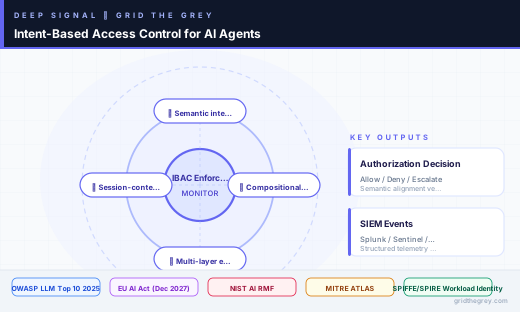
Intent-Based Access Control for AI Agents
How to prevent AI agents from executing harmful action sequences that pass traditional access controls but violate user intent.
Microsoft has released an expanded Zero Trust for AI strategy including a new AI-focused Zero Trust Assessment tool, a DevSecOps pillar in its Zero Trust Workshop, and an e-book covering security controls for autonomous and agentic systems. For defenders, this signals growing recognition that agentic AI pipelines introduce novel trust boundary failures that existing Zero Trust implementations do not adequately cover. Security teams should treat the new assessment tooling as a gap-analysis baseline while acknowledging that formalising AI agent governance also surfaces and codifies previously implicit attack surfaces attackers can now probe systematically.
CrowdStrike has extended its Falcon AI Detection and Response (AIDR) capability to cover Microsoft Copilot Studio agents and Anthropic Claude Code, bringing behavioural monitoring to two fast-growing agentic AI surfaces. This expansion signals that enterprises are actively deploying autonomous agents in production environments that previously lacked dedicated security tooling. Defenders now have a detection layer for these platforms, but the expanded integration surface also introduces new ingestion and telemetry trust boundaries that adversaries may probe.
Deno has released Claw Patrol, an open-source security firewall designed to sit between AI agents and production systems, intercepting and policy-gating actions before they reach critical infrastructure. The tool addresses the growing threat of excessive agency in agentic AI systems by allowing operators to write HCL rules that can block destructive operations or require human approval for sensitive actions like Kubernetes pod deletions. This represents a practical defensive tooling response to the OWASP LLM08 Excessive Agency risk, which has become increasingly acute as autonomous agents gain broader access to production environments.
Adversa AI's AI Risk Quadrant report evaluated 100 AI agents across ten categories, finding that only 11 qualify as both capable and well-defended. The research identifies a structural 'power-protection inversion' where the most capable agents also present the widest attack surface, driven by a 'lethal trifecta' of private data access, exposure to untrusted content, and outbound action capability. Computer and coding agents showed the most severe exposure, raising urgent concerns about autonomous agent deployment in enterprise environments.
Anthropic has published detailed documentation of its sandboxing architecture across Claude.ai, Claude Code, and Claude Cowork, including disclosure of a previously identified credential exfiltration vector via the api.anthropic.com/v1/files endpoint. The writeup covers process-level isolation technologies including gVisor, Seatbelt, Bubblewrap, and full VM approaches, and candidly acknowledges security gaps that were missed. This transparency is notable for the agentic AI space, where sandbox documentation is typically sparse and trust is difficult to calibrate.
◉ AI THREAT BRIEFING
Twice-weekly digest of critical AI security developments — every story mapped to MITRE ATLAS and OWASP LLM Top 10. Free.
No spam. Unsubscribe anytime.