LIVE FEED
FIRST LOOK Yellow Teams Bring AI Offense and Defense Into One Security Function // FIRST LOOK Tracebit Ships AWS Context Bombing Defence Against AI Hacking Agents // FIRST LOOK FriendMachine Launches Jacquard Lang for AI-Written Code Review // CRITICAL Check Point 2026 AI Security Report: LLMs Now Run Live Attacks // FIRST LOOK OpenAI GPT-5.6 Sol Ships Faster Parallel Tool-Use for Agents // FIRST LOOK Meta Launches Muse Image with Public Instagram Photo Reuse // FIRST LOOK Estonia Launches State-Issued Digital IDs for AI Agents // HIGH AI Widens Skill-Ability Gap, Enabling Autonomous Cyberattacks // FIRST LOOK OpenAI Expands ChatGPT Into Family and Caregiver Households // FIRST LOOK Iroh Launches Mesh LLM for Distributed AI Across Peer Nodes //
FriendMachine Launches Jacquard Lang for AI-Written Code Review

FriendMachine Launches Jacquard Lang for AI-Written Code Review

FIRST LOOK ATLAS OWASP MEDIUM Moderate risk · Monitor closely ▲ 6.2 HN AI Security

Jacquard is an open-source programming language purpose-built for a workflow where ML models generate code and humans review it, featuring a compact surface syntax, OCaml-based checker, and C-emitting compiler. This human-in-the-loop design introduces a new class of trust boundary risk: defenders must assess whether the review layer provides genuine semantic verification or creates a false sense of security that sophisticated AI-generated code can exploit. Supply chain and prompt-injection-adjacent risks emerge when the AI code-generation step itself becomes a target for adversarial manipulation, producing subtly malicious output that passes superficial human review.

SQLite Blocks AI-Generated Code Contributions

SQLite Blocks AI-Generated Code Contributions

ATLAS OWASP MEDIUM Moderate risk · Monitor closely ▲ 6.2 Simon Willison

SQLite has formally prohibited agentic code contributions and strengthened its policy language, reflecting growing concern over AI-generated submissions overwhelming open source maintainers. The project was forced to create a separate bug forum after being flooded with AI-generated reports of inconsistent quality. This represents an emerging operational security challenge for critical infrastructure software projects targeted by autonomous AI coding agents.

AI Agents Weaponise Vulnerability Discovery as AI-Generated Code Expands Attack Surface

AI Agents Weaponise Vulnerability Discovery as AI-Generated Code Expands Attack Surface

ATLAS OWASP HIGH Significant risk · Prioritise patching ▲ 7.5 Dark Reading

AI agents are now capable of autonomously discovering and exploiting obscure software vulnerabilities, raising the stakes for defenders already struggling with the volume of potentially insecure AI-generated code flooding codebases. The convergence of agentic exploitation capabilities and mass AI-assisted development creates a compounding risk: more vulnerabilities introduced at scale, and more capable automated systems to find and abuse them. Security teams must adapt their tooling, processes, and threat models to account for both sides of this AI-driven equation.

Rust Compiler Tightens LLM Code Policy for Supply Chain

Rust Compiler Tightens LLM Code Policy for Supply Chain

ATLAS OWASP MEDIUM Moderate risk · Monitor closely ▲ 6.2 HN AI Security

The Rust compiler project (rust-lang/rust) is formalising a policy governing LLM use in contributions, signalling growing institutional recognition of AI-generated code risks in critical infrastructure. The policy, proposed via pull request on rust-forge, is scoped to the core compiler repository and will be linked from contribution guidelines. This represents a significant governance precedent for open-source security-critical projects managing supply chain integrity amid widespread LLM-assisted development.

Claude Code Source Leak Exposes 512K Lines of Code

Claude Code Source Leak Exposes 512K Lines of Code

ATLAS OWASP MEDIUM Moderate risk · Monitor closely ▲ 6.2 HN AI Security

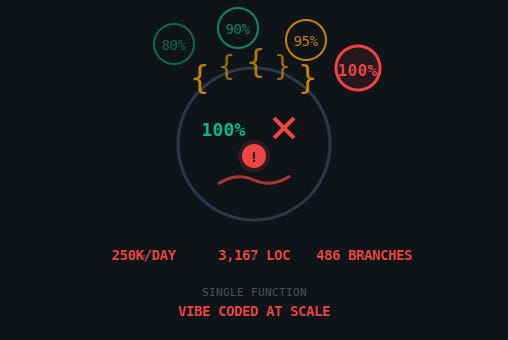
A packaging error exposed 512,000 lines of Claude Code's source, revealing severe code quality issues including a 3,167-line monolithic function, undocumented API waste, and regex-based sentiment analysis in an LLM product — raising questions about the security posture of AI-generated codebases. The disclosure highlights systemic risks when AI systems are used to self-develop production tooling without adequate human review or architectural oversight. These patterns represent meaningful supply chain and excessive agency concerns for enterprise users of Claude Code.

◉ AI THREAT BRIEFING

Stay ahead of the threat.

Twice-weekly digest of critical AI security developments — every story mapped to MITRE ATLAS and OWASP LLM Top 10. Free.

No spam. Unsubscribe anytime.