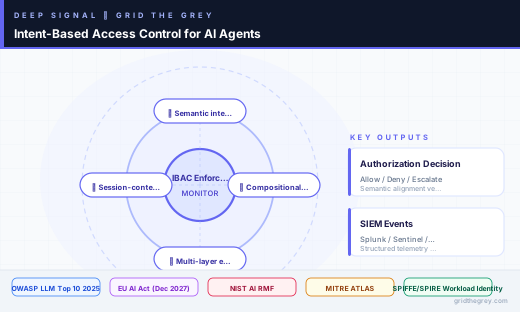
Intent-Based Access Control for AI Agents
How to prevent AI agents from executing harmful action sequences that pass traditional access controls but violate user intent.
Yellow teams are an emerging security practice in which engineers build both offensive and defensive AI tools to stress-test AI capabilities and expose vulnerabilities before adversaries do. This dual-role model compresses the feedback loop between red and blue functions, but it also concentrates privileged knowledge of exploitable AI weaknesses in a small group with broad system access. Defenders should assess the insider-risk and knowledge-management implications of consolidating offensive AI tooling within a single team.
Microsoft has deployed MDASH (Multi-model Agentic Scanning Harness), an AI-powered agentic system that autonomously scans Windows binaries for vulnerabilities and validates findings through multiple AI models before human engineer review. The accelerated discovery pipeline means defenders will see a higher volume of Patch Tuesday fixes, compressing patch deployment windows and increasing pressure on enterprise patch management processes. Simultaneously, the same AI-accelerated vulnerability discovery capability is available to adversaries, raising the risk that threat actors identify and weaponise flaws faster than Microsoft's pipeline can remediate them.
May 2026 saw a wave of cybersecurity acquisitions with a clear focus on securing AI agents and LLM infrastructure, including Cisco's ~$400M acquisition of Astrix Security for non-human identity management and Check Point's acquisition of Deepchecks for LLM evaluation and continuous monitoring. Akamai also moved to acquire LayerX for AI usage control and agentic activity visibility across browsers and IDEs. These deals signal that enterprise security vendors are racing to build defensive capabilities around the expanding agentic AI attack surface.
Artemis, a cybersecurity startup focused on AI-powered threat defence, has emerged from stealth with $70 million in funding, positioning itself to counter AI-driven attacks across applications, users, endpoints, and cloud workloads. The emergence signals growing investor confidence in purpose-built AI security platforms designed to address the escalating threat landscape of adversarial AI. While details on specific technical capabilities remain sparse, the company's broad scope suggests coverage of multiple attack surfaces increasingly targeted by AI-enabled threat actors.
CrowdStrike, as a founding member of Anthropic's Mythos program, is highlighting the security challenges posed by increasingly capable frontier AI models, signaling a growing industry focus on securing agentic and large-scale AI systems. The article underscores the philosophical and practical position that AI capability gains must be matched by proportional security investment. While the piece is primarily a vendor partnership announcement and executive viewpoint, it reflects an important industry trend toward formalising AI-specific security frameworks and tooling.
◉ AI THREAT BRIEFING
Twice-weekly digest of critical AI security developments — every story mapped to MITRE ATLAS and OWASP LLM Top 10. Free.
No spam. Unsubscribe anytime.