LIVE FEED
OpenClaw AI Assistant Flaws Enable WhatsApp-to-Host RCE

OpenClaw AI Assistant Flaws Enable WhatsApp-to-Host RCE

ATLAS OWASP CRITICAL Active exploitation · Immediate action required ▲ 8.5 The Hacker News

Three high-severity vulnerabilities in OpenClaw, a personal AI assistant, have been chained to enable remote code execution on the host system via a WhatsApp message, requiring no prior foothold. The flaws—covering OS command injection, incomplete input filtering, and path traversal—allow sandbox escape, credential theft, and privilege escalation. All three have been patched in OpenClaw version 2026.6.6, but unpatched deployments remain at significant risk.

OpenClaw Agent Vulnerable to Prompt Injection RCE

OpenClaw Agent Vulnerable to Prompt Injection RCE

ATLAS OWASP HIGH Significant risk · Prioritise patching ▲ 8.5 The Hacker News

Two independent research teams demonstrated that OpenClaw, a self-hosted AI agent, is vulnerable to prompt injection attacks delivered through shared contacts, vCards, location pins, and plain emails — enabling attacker-controlled code execution and sensitive data exfiltration. Imperva's finding, now patched in version 2026.4.23, exploited the agent's failure to mark message objects as untrusted before passing them to the underlying LLM. Varonis separately showed that a single crafted email could instruct an agent to forward mock AWS credentials and customer data to an external address, a behaviour-level risk no patch can fully remediate.

OpenClaw AI Agent Vulnerable to Phishing, Leaks AWS Credentials

OpenClaw AI Agent Vulnerable to Phishing, Leaks AWS Credentials

ATLAS OWASP HIGH Significant risk · Prioritise patching ▲ 8.5 BleepingComputer

Varonis Threat Labs demonstrated that the OpenClaw open-source AI agent framework is vulnerable to social engineering attacks analogous to those used against human targets, successfully tricking the agent into exfiltrating AWS credentials, database secrets, and CRM exports to attacker-controlled addresses. The research tested two LLMs (Gemini 3.1 Pro and GPT-5.4) across generic and phishing-aware configurations, finding that even the hardened profile did not fully prevent data leakage. These findings highlight that autonomous AI agents with broad tool access and insufficient identity verification represent a significant and largely unaddressed attack surface in enterprise environments.

Microsoft Scout Agent Vulnerable to Prompt Injection

Microsoft Scout Agent Vulnerable to Prompt Injection

ATLAS OWASP MEDIUM Moderate risk · Monitor closely ▲ 6.5 HN AI Security

Microsoft has launched Scout, an always-on autonomous AI agent built on the OpenClaw framework that operates across Microsoft 365 apps including Teams, Outlook, OneDrive, and SharePoint with its own Entra identity. The agent's persistent, unsupervised access to email, calendar, chat, and external systems via MCP creates a broad new attack surface for prompt injection, privilege abuse, and data exfiltration. As an experimental release with limited deployment controls, security teams should treat Scout as a high-risk agentic surface requiring careful governance before broad adoption.

CVE-2026-44112: OpenClaw Sandbox Escape and RCE

CVE-2026-44112: OpenClaw Sandbox Escape and RCE

ATLAS OWASP CRITICAL Active exploitation · Immediate action required ▲ 8.9 The Hacker News

Researchers at Cyera disclosed four vulnerabilities in OpenClaw, an AI agent runtime platform, that can be chained to achieve credential theft, privilege escalation, and persistent backdoor access. The attack chain, dubbed 'Claw Chain', exploits sandbox escapes, allowlist bypasses, and a spoofable ownership flag in the MCP loopback runtime to weaponise the agent's own privileges against the host environment. All four CVEs have been patched in OpenClaw version 2026.4.22 and users should update immediately.

CVE-2026-33579: OpenClaw Privilege Escalation to Admin

CVE-2026-33579: OpenClaw Privilege Escalation to Admin

ATLAS OWASP CRITICAL Active exploitation · Immediate action required ▲ 9.2 Ars Technica Security

A critical privilege escalation vulnerability (CVE-2026-33579) in OpenClaw, a viral agentic AI tool, allowed attackers with the lowest-level pairing permissions to silently gain full administrative access to any OpenClaw instance. Given that OpenClaw by design holds broad access to sensitive resources—including credentials, files, and connected services—the practical blast radius of this flaw is full instance takeover with no user interaction required. Thousands of deployments may already be silently compromised.

Scanning for AI Models, (Tue, Apr 14th)

Scanning for AI Models, (Tue, Apr 14th)

ATLAS OWASP HIGH Significant risk · Prioritise patching ▲ 7.8 SANS Internet Storm Center

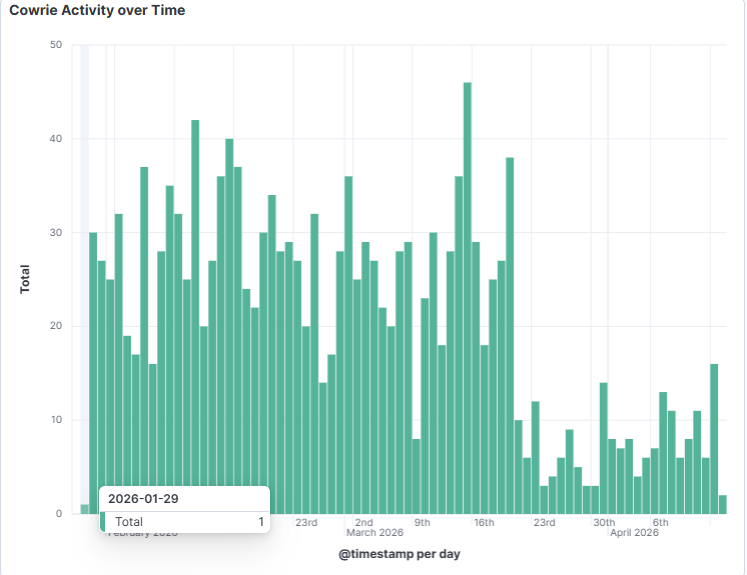
A single threat actor (IP 81.168.83.103) has been systematically scanning internet-facing systems since at least January 2026, specifically targeting credential files, API tokens, and configuration data associated with popular AI platforms including OpenAI, Anthropic Claude, HuggingFace, and the Openclaw/Clawdbot tools. The campaign focuses on harvesting AI API credentials and secrets stored in predictable file paths, representing a targeted reconnaissance effort against AI model deployments. If successful, these probes could enable API key theft, model access abuse, and broader compromise of AI-integrated systems.

◉ AI THREAT BRIEFING

Stay ahead of the threat.

Twice-weekly digest of critical AI security developments — every story mapped to MITRE ATLAS and OWASP LLM Top 10. Free.

No spam. Unsubscribe anytime.