The Security Analyst's Claude Code Playbook
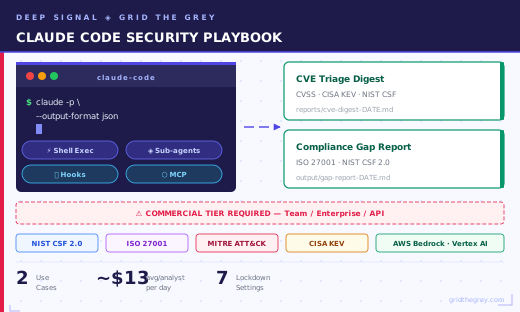
A practitioner's guide to deploying Claude Code in security operations — threat intelligence automation, compliance gap analysis, token management, and enterprise hardening.
Dragos has launched EmberAI, an AI module embedded within its OT security platform that allows analysts to query threat intelligence, asset data, and network activity in plain language, grounded in a decade of proprietary OT-specific data. The system introduces new attack surface considerations because it aggregates highly sensitive OT network telemetry, vulnerability data, and adversary intelligence into a single AI-queryable layer — making the platform itself a high-value target. Defenders must weigh the risks of prompt injection, over-reliance on AI-generated recommendations in safety-critical environments, and the intelligence value this consolidated dataset represents to nation-state adversaries.
A new class of agentic AI security platforms is emerging that autonomously correlates threat intelligence, validates controls, and prioritizes remediations across siloed enterprise security tooling — moving beyond assistive chatbot interfaces to continuous, multi-step autonomous action. This shift introduces significant new attack surface: an AI system with persistent access to live exposure data, security telemetry, and remediation workflows becomes a high-value target for adversarial manipulation. Defenders must assess trust boundaries, prompt injection risks, and the consequences of autonomous action taken on poisoned or manipulated inputs before deploying these systems.
Cisco Talos researcher Martin Lee demonstrates how generative AI can be used to rapidly deploy adaptive honeypot systems that deceive and study AI-driven attack agents. The technique exploits a fundamental weakness in AI agents — their lack of situational awareness — causing them to interact with simulated vulnerable systems as if they were real targets. This defensive approach shifts the paradigm from passive detection to active manipulation, giving defenders new insight into automated threat actor methodologies.
A single threat actor (IP 81.168.83.103) has been systematically scanning internet-facing systems since at least January 2026, specifically targeting credential files, API tokens, and configuration data associated with popular AI platforms including OpenAI, Anthropic Claude, HuggingFace, and the Openclaw/Clawdbot tools. The campaign focuses on harvesting AI API credentials and secrets stored in predictable file paths, representing a targeted reconnaissance effort against AI model deployments. If successful, these probes could enable API key theft, model access abuse, and broader compromise of AI-integrated systems.
A new academic paper analysed over 160 cybercrime forum conversations to understand how threat actors are discussing and adopting AI tools for criminal purposes. The research documents both misuse of legitimate AI platforms and attempts to build bespoke criminal AI models, revealing early-stage diffusion of AI capabilities within cybercriminal communities. The findings carry practical implications for law enforcement and security practitioners monitoring the evolving AI-enabled threat landscape.
◉ AI THREAT BRIEFING
Twice-weekly digest of critical AI security developments — every story mapped to MITRE ATLAS and OWASP LLM Top 10. Free.
No spam. Unsubscribe anytime.