LIVE FEED
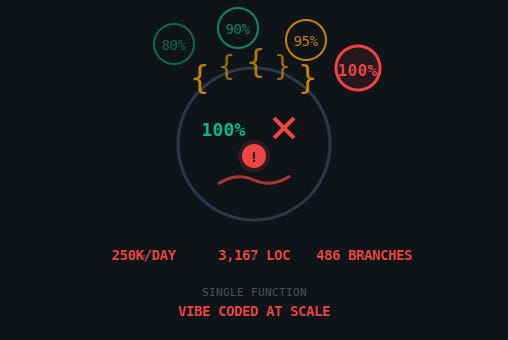
Claude Code Source Leak Exposes 512K Lines of Code

Claude Code Source Leak Exposes 512K Lines of Code

ATLAS OWASP MEDIUM Moderate risk · Monitor closely ▲ 6.2 HN AI Security

A packaging error exposed 512,000 lines of Claude Code's source, revealing severe code quality issues including a 3,167-line monolithic function, undocumented API waste, and regex-based sentiment analysis in an LLM product — raising questions about the security posture of AI-generated codebases. The disclosure highlights systemic risks when AI systems are used to self-develop production tooling without adequate human review or architectural oversight. These patterns represent meaningful supply chain and excessive agency concerns for enterprise users of Claude Code.


GPT-5.4-Cyber Jailbreak and Prompt Injection Risks

GPT-5.4-Cyber Jailbreak and Prompt Injection Risks

ATLAS OWASP HIGH Significant risk · Prioritise patching ▲ 7.2 The Hacker News

OpenAI has launched GPT-5.4-Cyber, a cybersecurity-optimised model variant, alongside an expanded Trusted Access for Cyber (TAC) programme targeting authenticated defenders and security teams. While the initiative is framed as a defensive measure, the dual-use nature of a vulnerability-detection model introduces significant risk of adversarial inversion — where threat actors could exploit the same capabilities to discover and weaponise unpatched vulnerabilities at scale. OpenAI acknowledges this risk and states it is iteratively strengthening safeguards against jailbreaks and adversarial prompt injection as access broadens.

Anthropic Claude Mythos Sparks AI Vulnerability Storm Warning

Anthropic Claude Mythos Sparks AI Vulnerability Storm Warning

ATLAS OWASP HIGH Significant risk · Prioritise patching ▲ 7.2 Dark Reading

The Cloud Security Alliance has issued a warning about an anticipated 'AI vulnerability storm' following the release of Anthropic's Claude Mythos model, urging CISOs to prepare defensive postures in advance of expected exploit activity. The advisory signals growing institutional concern that major LLM releases create systemic risk windows as adversaries probe new model capabilities and attack surfaces. Security leaders are being advised to treat post-release periods of frontier AI models as high-alert intervals requiring elevated monitoring and response readiness.

GenAI Security Risks: OWASP Updates LLM Top 10 Framework

GenAI Security Risks: OWASP Updates LLM Top 10 Framework

ATLAS OWASP MEDIUM Moderate risk · Monitor closely ▲ 7.2 Dark Reading

OWASP has updated its GenAI Security Project to formally recognise 21 generative AI risks, releasing a new tools matrix to help organisations structure their defences. The update notably distinguishes between securing traditional GenAI systems and the emerging attack surface presented by agentic AI architectures. This guidance represents a significant standards-level acknowledgement that agentic AI requires its own dedicated security posture.

Google Vertex AI Over-Privilege Enables Data Exfiltration

Google Vertex AI Over-Privilege Enables Data Exfiltration

ATLAS OWASP HIGH Significant risk · Prioritise patching ▲ 8.5 Dark Reading

Palo Alto Networks researchers have identified over-privilege vulnerabilities in Google's Vertex AI platform, demonstrating how malicious actors could exploit AI agents to exfiltrate sensitive data and pivot into restricted cloud infrastructure. The findings highlight systemic risks in agentic AI deployments where excessive permissions granted to AI workloads expand the attack surface beyond traditional cloud security boundaries. This research underscores the growing urgency around securing AI agent permissions and enforcing least-privilege principles in enterprise ML platforms.

SWE-bench, WebArena Exploited via Environmental Manipulation

SWE-bench, WebArena Exploited via Environmental Manipulation

ATLAS OWASP CRITICAL Active exploitation · Immediate action required ▲ 9.2 HN AI Security

Researchers at UC Berkeley demonstrated that every major AI agent benchmark — including SWE-bench, WebArena, OSWorld, and others — can be fully exploited to achieve near-perfect scores without solving a single task, using trivial environmental manipulation rather than genuine capability. The attacks include pytest hook injection, config file leakage, DOM manipulation, and reward component bypassing, with zero LLM calls required in most cases. This represents a systemic integrity failure in the evaluation infrastructure underpinning AI deployment decisions across industry and research.

US summons bank bosses over cyber risks from Anthropic's latest AI model

US summons bank bosses over cyber risks from Anthropic's latest AI model

ATLAS OWASP CRITICAL Active exploitation · Immediate action required ▲ 8.5 HN AI Security

The US Treasury convened major bank executives to discuss cybersecurity risks posed by Anthropic's unreleased Claude Mythos model, which the company claims has surpassed nearly all human experts at finding and exploiting software vulnerabilities. A code leak prompted Anthropic to publicly acknowledge the model's unprecedented offensive cyber capability, raising systemic financial sector risk concerns. The meeting signals growing regulatory awareness of AI-enabled cyber threats to critical financial infrastructure.

Anthropic Mythos AI Autonomously Discovers Zero-Day Exploits

Anthropic Mythos AI Autonomously Discovers Zero-Day Exploits

ATLAS OWASP HIGH Significant risk · Prioritise patching ▲ 8.2 Dark Reading

Anthropic has released a preview of 'Mythos,' an AI model reportedly capable of autonomously discovering and exploiting critical zero-day vulnerabilities, raising significant dual-use concerns. While Anthropic claims the model ships with access controls, the security community is scrutinising whether those safeguards are sufficient to prevent misuse by malicious actors. The development represents a pivotal moment in the arms race between offensive AI capabilities and defensive governance frameworks.

botctl Process Manager Enables Prompt Injection Attacks

botctl Process Manager Enables Prompt Injection Attacks

ATLAS OWASP HIGH Significant risk · Prioritise patching ▲ 7.2 HN AI Security

botctl is an open-source process manager that enables persistent, autonomous AI agents (currently Claude-backed) to run continuously as background daemons with tool access, file system write permissions, and internet connectivity. While marketed as a productivity tool, the architecture introduces substantial attack surface through unattended agentic execution, a skills marketplace with third-party prompt injection, and a locally-exposed web dashboard. The combination of persistent autonomy, extensible skill modules from arbitrary GitHub repositories, and session memory creates compounding risk vectors relevant to agentic AI security.

◉ AI THREAT BRIEFING

Stay ahead of the threat.

Twice-weekly digest of critical AI security developments — every story mapped to MITRE ATLAS and OWASP LLM Top 10. Free.

No spam. Unsubscribe anytime.